London Grammar is a British trip formed by Hannah Reid, Dan
Rothman, and Dominic Major. Their début EP Metal and Dust was released in
February 2013 by Metal and Dust Recordings Ltd. Their début album 'If You Wait' was released on 9th September 2013 and set platinum certification by
the British Phonographic Industry association.
Both vocalist Hannah Reid and Dan Rothman originated from
London and met in a residence hall at the University of Nottingham during their
first year in 2009. Rothman saw a picture of Reid with her guitar on Facebook
and immediately sent her a message to see if she wanted to collaborate. They were
joined by Dominic Major after a year later, after he began playing music
together with Rothman. They chose the name, London Grammar as "not only was it
where we’re from, but London is also so international and multicultural that it
actually felt like a universal name in a way".
After completing their studies in 2011, the trio moved down
to London to pursue their career in music. By the end of the year, they were
managed by Connor Wheeler who began promoting them. The band began by playing
low-key gigs at local bars, honing their material. They soon found themselves
noticed by the A&R people and they were signed with the Ministry of Sound
in the second half of 2012. On 12th December 2012, they posted their
song ‘Hey Now’ on YouTube, receiving a large amount of attention due to anonymity
of the band caused by a lack of promotional photographs. As you can see,
majority of their artwork featured landscapes and city centres of London and
very rarely featured them, additionally creating a mystique sense of attention.
Their EP Metal and Dust followed in February 2013, making
the top five in the iTunes chart of Australia. It created a lot of interest and
the band received significant airplay on national radio. They released ‘Wasting My Young Years’ in June 2013, reaching number 31 on the UK Singles Chart. The band
also featured on Disclosure #1 UK album Settle with the track ‘Help Me Lose My
Mind’, released in June 2013. The band recorded two live sessions for Radio 1
and they played at ten summer 2013 European music festivals.
On 1 September 2013, they released ‘Strong’ which reached
number 16 on the UK Singles Chart. The
following week, on the 9th, they released their début studio album ‘If You Wait’ which reached number 2 on the UK Albums Chart, number 2 on the Australian
Albums Chart, number 11 on the French Album’s Chart, number 13 on the Irish
Album Chart and number 22 on the New Zealand’s Album Chart. They are now signed
to Columbia Records in the USA.
London Grammar has the type of music that can be described as
‘a blend of ambient, ethereal and classical sounds’ with melancholy guitar, soaring
vocals and plaintive lyrics. The songs are a collaborative effect as Reid
explains: ‘I write the all the lyrics and the top lines. But the songs initiate
from all three of us. Dot will write a piano part of a music score. Dan will
add some guitars.’ She describes the songs as ‘emotionally affected’ and writes
about people who come in and out of my life. The song, ‘Wasting My Young Years’,
which has received over 10 million views on YouTube, was written about her
ex-boyfriend.
Our groups chosen song is ‘Darling Are You Gonna Leave Me’
by the band London Grammar. The reason for this was due to the originality this
song has from the beat of the drums to the artist’s voice. This provides an interesting
and visionary approach towards the planning of this music video as we have the capacity
to combine various ideas into this music
video, the use of quick cuts throughout any music video in general puts us to
an advantage, if we were to face the problem of having too many ideas.
As a group we analysed the lyrics to this song, although the chorus was consistent in terms of repeating two lines, we came across various interpretations accessible to inspire new ideas.
The official music video for ‘Human’ premiered on January 3,
2014 and was uploaded to Perri’s YouTube account the following day. The video
was directed by Elliot Sellers and features Perri as a robot sitting in the white
room, with close-ups of the mechanics working inside of her body. As Perri
begins to move, various body parts are shown to be bionic. Towards the end of
the video, Perri begins to transform from a machine into a human as sparks fall
behind her; her tattoos reappear as a symbol of her individuality and her
robotic heart begins to pump fluid around.
Perri’s music video opens with shows some sort of machinery,
perhaps mirroring a human heart, spluttering sparks. This could be interpreted
as the imperfections in perfection; the use of robotic elements contains
stereotypes of perfection but with this heart-like feature spluttering sparks
portrays a lacking in robotic features. The music involved in this creates a
crescendo that abruptly stops as the next scene features Perri herself. The use
in such abruptness portrays the sudden turn off of a machine system that could
occur in an instant with the mere press of a button.
In these shots, the instrumental of the song moves in sync
to the lightening and the enlargement of the screen. Perri sits in the centre
of the room on some sort of round table; the lighting has altered between these
two screen shots of the video. One consists of less lighting, enveloping Perri
in a silhouette form, while the other spotlight’s Perri’s features
completely. The use of lighting here, is
largely effective solely due to the exposure of something alternative to
mundane, to the viewers. For instance when we come across the silhouette Perri,
we see her in exactly the same position as before, but with a slight
alteration. Viewers come across some sort of robotic wiring in the back of her
thighs and stomach. These show complementariness to the lyrics for this song as
they desire some sort of perfectionist from the singer hence putting her in a
robotic state.
The use of a closeup shot in this particular shot has the
purpose of two reasons: Firstly, conforming to Goodwin’s theory of the demand
in close ups of the artist for viewers to easily recognise the artist and
secondly to display the unusual eyes that Perri has. Her irises have some sort
of mechanical or artificial light around the edges, creating an unusual and
inhuman effect. Again, this conforms to Goodwin’s theory as the use of these
eyes is amplifying to the lyrics of the song. At this point of the song, the
artist has already started to sing. However, in the music video Perri doesn’t
sing along with it. This is again something that can be considered as
associative to the lyrics because viewers are expectant of her to sing, but she
doesn’t. Although, later on in the music video she does begin to sing along
with the song, but at the moment it is hard to depict whether this is a
performance-based music video or narrative based. This confusion could be
considered as something the video emits, an attempt to display Perri’s confusion,
whether she is human or a robot.
The camera displays a brief movement, highlighting Perri’s
features. From the above screenshot, to this, the camera develops a swift
panning movement which connects to these shots maintaining constancy in the
sequence and thus music video. Again, the highlighting of these features and
camera movements associate to the song, display a close up of Perri’s features
and perhaps question the stillness and perfection in her posture suggests
inhuman physical characteristics.
All through the first verse of the song , we come across
quick cuts to moving mechanical devices. Throughout the first verse of the
song, we also come across different angles and camera movements of Perri fixed
in the same position. The idea behind this could be that the constancy in these
mechanical devices carrying out the same task repeatedly could be similar to
the repetitive demands asked of Perri. Her fixed position is complementary to
the fixed tasks these mechanical devices are programmed to do, almost
portraying her programmed to sit in that position. However, it can also be considered that these mechanical movements are perhaps internal models in Perri that are preparing for Perri to move, suggesting cyborg qualities.
The build up to the chorus features shots of Perri beginning
to slowly move in sync to the song. This could a crosslink to the lyrics as during
the chorus she highlights the humanity in her and outcomes Humans would likely
come across if they were to come across such impossible tasks. As well as
Perri’s change in position, changing in lighting also becomes evident. The room
suddenly becomes brighter and clearer, highlighting and exposing the appearance
of Perri and lightly pulsing to the keys of the piano, almost as if it were
mimicking a pulse. As opposed to the contrast of dark and light evident during
the first verse as the room constantly changes in brightness to the tune of the
song, perhaps mimicking a functional robot. These two techniques in terms of
the lighting remain this way through the whole music video, amplifying the
contrast between perfection to a state where a person develops robotic features
or human qualities in while a person makes mistakes.
Again, different angles of the same behaviour (which in this
case is Perri walking) has portrayed, one of which involves a shadow of Perri
walking. This idea is simple, yet holds curiosity in the video hooking viewers
in. Cuts throughout the music video take a slow pace, as if viewers are
required to take in Perri. The setting itself is bathed in white with
flickering lights, it can be considered that the white room Perri is in may be
some sort of prison or perhaps a stereotype of a white room where the mentally
ill are locked. The main purpose of this is to show entrapment and captivity
that the demand in perfection is causing off Perri.
During this bridge, the pace begins to quicken as we come
across quick cuts and flickering. This is in correspondence to the crescendo of
the song and its bridge. This complements Andrew Goodwin’s theory as during the
bridge of the song, the shots complement to the crescendo, creating a montage
of the sparks flying from her internal system and flashes of Perri singing.
Also during the flashes to wear Perri sings we also come across a flickering
effect, much like the flickering effect I casted on my flashback scenes in my
movie opening. However, these effects displayed sparks emitting off the screen.
The utilisation of Perri’s tattoos revealed to the viewer’s
suggests a sense of individuality, a common trait humans share. The sparks raining
upon Perri and the shot of her robotic heart pumping blood suggests Perri’s
transformation from robot to human. This is revealed through the close up shots
of her tattoos on her forearm and the close up shot of her arm drawing in blood
as well as the wide shot displaying falling sparks are illustrative of her
robot features disappearing, and in its place forming a human. The shot of the
robot heart drawing in blood is again evidence of this transformation and
conveys another point conforming to Andrew Goodwin and the association between
lyrics and visual effects.
Watching Behind The Scenes of Perri's Human music video was an interesting experience. having first hand views on the music video by the director and Perri. As well as the bases to these different unique shots used in the video, I learned the basis to the song and why it was so simplistic which was because a dramatic song like this did not require a story line to the video.
The music video was released on July 17, 2013. The video
was directed by Ryan Pallota and Demi Lovato. The video marks a directorial
debut of Lovato, where she is co-directed. Lovato explained the video as a
couple "who meet at a carnival and they fall head over heels in
love".
The video begins when Lovato visits a carnival and performs the opening of the song. Soon, the focus switches to follow the love story of a young American couple. Initially, the video shows the pair throughout their dating phase. One day, the boy must leave, and it is revealed that he is a soldier being deployed in the middle of war. He promises to return, and meanwhile, the girl is left alone at home. The two attempts to stay in contact by writing letters to one another, and the girl anxiously await his correspondence. The next scene shows a flashback to the carnival from the beginning of the video, where the girl hangs out with her friends until she sees the boy for the first time, working at the carnival. As the boy follows her around the carnival, Lovato performs the song. The climax of the story portrays a chaotic scene with the boy in a battlefield, shots ringing all around him. Simultaneously, the girl begins to shut herself in her room, worried about her boyfriend, and it seems as if he will die. In the end, the boy returns and reunites with his girlfriend. The video ends with Lovato smiling at the camera.
Lovato’s music video opens with shots accompanied by the
sound of wind blowing; with the slow pace created by slow motion and the use wind
blowing allows the music video to feature memories and thoughts that these two characters-
presumably boyfriend and girlfriend- share., setting up the narrative. It
creates a sense of isolation, which leads to the reminiscence of memories. This
creates enigma through the slight insight in their story, illustrated through
these shots, which is later revealed as the music video proceeds.
As the video continues, we come across fragments of sound
gradually accompanying these shots. Layer upon layer, different sounds are
added to the clip, for instance the second sound to the wind blowing can be
considered as some sort of static sound foreshadowing some sort of parting and
inability to contact between the two characters, the third sound added on top
of this is of people talking in a rushed manner a memory from war which is
complemented from a few gunshot sounds added, the fourth sound added mocks a
carnival atmosphere perceived as another memory or how their story
started.
The sounds fade, alongside 180 degrees shot rotation shot,
starting from behind Lovato’s head and ending at the camera facing Lovato. The
video pauses in silence for a second or two before Lovato starts singing and
the beat kicks in. The use of utter silence after the slight crescendo in
different layers of sound on top of each other creates an element of suspense,
but also brings viewers the excitement of having the chance to be exposed to
their story.
The use of a carnival concept shapes the whole music video
and connotes the fact that this music video is aimed for younger people who
usually go out to the carnival, perhaps with their friends, producing a casual
setting. Carnivals are usually held in the summer, due to warmer nights and
hence the idea summer love is presented. Lovato being a young female and the
two characters also being of a similar age suggests the aim of this video
directed towards young girls. This is because the video presents romantic
relationship between these two characters and creates ideologies in the
audience such as love at first sight much like fairy tales which young girls
want and admire.
The use of dirt flying as the girl writes and the same dirt
flying near the boy’s feet creates some sort of communicational field between
the two characters. The dirt flying, begins as the girl writes her letter and
ends near the boys feet as he stares at her picture, thisseems as if letter is automatically received
by him and mimics a clever way of the letter being sent to the boy.
The use of letters showering the girl suggests a high level
of communication being kept by both parties. This conveys the want and need to
be with each other and hence portrays their unconditional love the two have. Another
key factor is, that she kept the letters again highlights on her missing him
and the want to be near him which she does through the use of letters.
·Night time suggests closure and an end to the
day.
·Portrayed behind bars suggests that they are
held back, providing this is a memory from when she is alone while he serves in
war.
·Rain could connote teardrops.
Again she’s in the same room.
Slight evidence of bars suggesting trapped with
the emotion of worrying and missing her boyfriend.
She stands alone looking out suggest longing and
isolation.
The boy is in army wear suggesting he is at war.
He stands alone, suggesting isolation.
The heavy load of army wear could perhaps
suggest the heavy weight of returning home to his girlfriend safe and sound as
well as surviving.
Wide shot used to display the location, perhaps
juxtaposing the two characters location.
Mise en scene portrays the destruction through
the use of smoke and fire and the danger surrounding the man.
Sympathy is gained for the two characters as
they are far from each other’s reach.
The light shining on the boy represents hope.
We cannot see his face which suggest hope
cascades his face.
Half of the frame is taken up by the light.
She is in the dark which suggests her light
belongs to the boy.
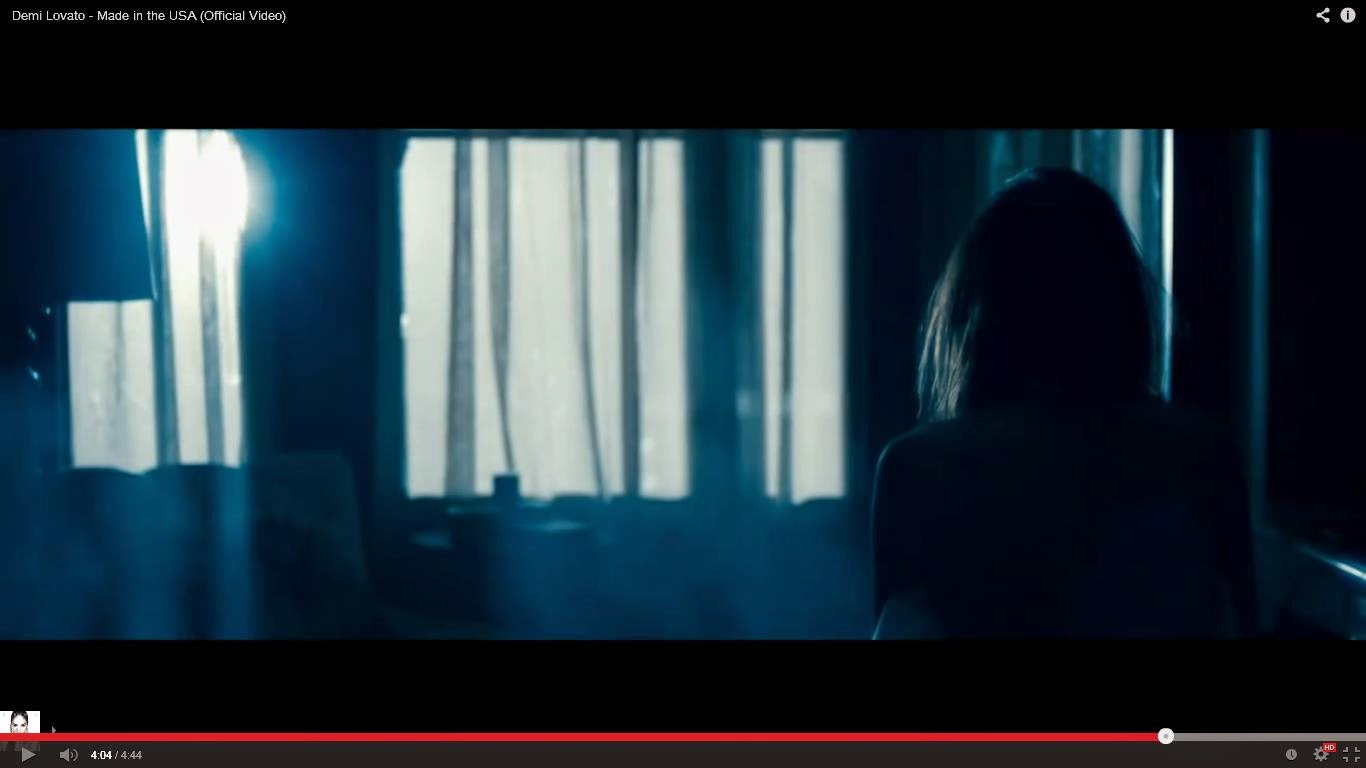
Mise En Scene depicts sadness with the use of
dull colours, dark shots and make up.
Majority of the frame is taken up by the window,
leaving only little space for the girl. This displays her as small and in need
for her boyfriend.
Longing for her boyfriend.
The use of red connotes danger and fear as she
sits alone.
The shadow of lines could be interpreted as bars
in which she is imprisoned with the emotions closing in on her.
The reddish mist could be considered like the
previous screenshot as a use of warning/danger.
The close up shot allows viewers to see the
emotion painted fear on his face.
His eyes are wide and his eyebrows are slightly
knit together shows the bodily response of worry.
A series of montages between the past (which is the couple’s
time spent together) and present day (which is the girl in constant distress
with the parting of her boyfriend and shots of the war zone the boy is faced
with) is accompanied with a speed up in pace. The use of quick cuts and more
shots evident from the bridge to the end of the song speed up in time to the
crescendo of the music, occasionally including Lovato performing herself, shows
a build-up in suspense by creating the
rhetorical question of ‘Will they be together in the end?’ in the viewer’s mind.
The fireworks and bombs stop, as shown in the Mise
En Scene.
A bright light shines through the window causing
a calm after the storm.
The bright light can also suggest and elevation
of hope.
The camera trails the boy from foot to head,
gradually revealing the boy.
The use of high angles light suggests he is
coming down from heaven, putting angelic features on the boy.
The room brightens, suggesting the girl is whole
again with the arrival of her boyfriend.
We were shown five music videos that made the UK top charts. While watching these music videos with an analytical approach, we jotted down key features displayed in the music video.
Some of these included:
Iconography
Dance routines
Typical party scenes for music videos of certain genres
Andrew Goodwin is a theorist, in his book, Dancing in the Distraction Factory, he identified the following features of music video:
Music videos demonstrate genre characteristics (eg stage performance in metal video, dance routine for boy/girl band).
There is a relationship between lyrics and visuals (either illustrative, amplifying, contradicting).
There is a relationship between music and visuals (either illustrative, amplifying, contradicting).
The demands of the record label will include the need for lots of close ups of the artist and the artist may develop motifs which recur across their work (visual style).
There is frequent reference to the notion of looking (screens within screens, telescopes, etc) and particular voyeuristic treatment of the female body.
There is often inter textual reference (to films, TV programmes, other music videos, etc).
There are also different ways of music video construction, which can be done trough:

 London Grammar is a British trip formed by Hannah Reid, Dan
Rothman, and Dominic Major. Their début EP Metal and Dust was released in
February 2013 by Metal and Dust Recordings Ltd. Their début album 'If You Wait' was released on 9th September 2013 and set platinum certification by
the British Phonographic Industry association.